Why Terminology Mistakes Cost Real Business
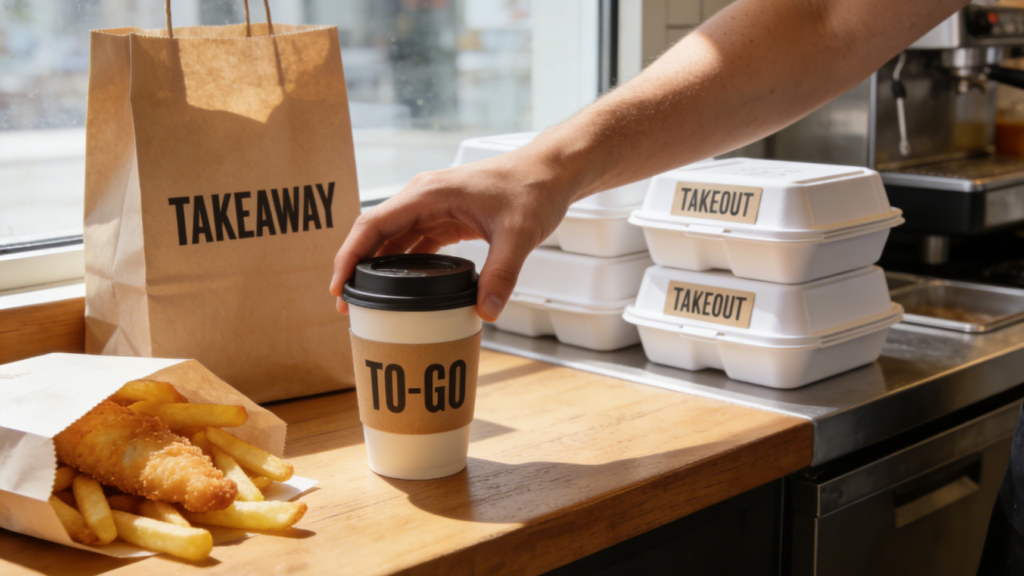
In the global foodservice packaging industry, using the wrong term can cost far more than you expect.
When a buyer in London searches for “takeaway boxes,” they are looking for packaging that complies with UK environmental standards and can handle saucy dishes like curry. When a restaurant owner in New York searches for “takeout containers,” they are likely sourcing scalable, brand-ready packaging suitable for bulk procurement.
They are searching for the same solution—but they will never use the same keyword.
Takeaway, To-Go, and Takeout represent three different commercial languages. The gap between them is an invisible but critical barrier between buyers and suppliers worldwide.
This article explains those differences clearly—and guides you toward the right solution for each market.
Decoding the Three Terms: How Your Customers Think
The core difference is geography, which directly shapes how buyers search, what they expect, and how they evaluate suppliers.
| Term | Dominant Markets | Core Meaning & Usage | Implications for Packaging |
|---|
| Takeaway | UK, Australia, New Zealand, Commonwealth markets | Noun. Refers to the food itself or the restaurant. Everyday usage.“Let’s get a takeaway.”“A fish and chips takeaway.” | Compliance-first: Strong focus on certified compostable packaging.Cultural fit: Packaging must suit local dishes (curries, fish & chips, saucy foods). |
| Takeout | United States, Canada (standard term) | Noun / adjective. Refers to off-premise food service. Neutral and professional.“We ordered takeout.”“Takeout menu.” | Scale & reliability: Designed for bulk purchasing and stable supply.Branding-ready: Custom printing and OEM needs are common. |
| To-Go | United States (dominant) | Adjective. Describes the act of taking food away. Focused on immediacy.“Coffee to-go, please.”“For here or to-go?” | Function-driven: Leak resistance, portability, heat control.Experience-led: Packaging directly affects consumer satisfaction. |
Key insight:
This is not a synonym problem.
Buyers who think in “Takeaway” are operating within a regulatory-driven, sustainability-focused system.
Buyers who think in “To-Go” are optimizing for speed and convenience.
Using the wrong term signals that you do not understand their market.
For procurement teams, terminology is often the first indicator of whether a supplier truly understands their region.
From Terminology to Opportunity: Matching Market with Solution
Once you understand the language your customers use, selecting the right packaging solution becomes straightforward.
For “Takeaway” Markets (UK, Australia, Commonwealth)

Buyers in these markets prioritize sustainability, compliance, and local relevance. They are not just purchasing containers—they are managing regulatory and brand risk.
For “Takeout” Markets (North America – B2B Standard)
Here, foodservice operators and distributors focus on consistency, scalability, and professional sourcing.
For “To-Go” Markets (U.S. Convenience-Driven Service)
In To-Go scenarios, packaging performance is inseparable from customer experience.
Why Buyers Choose to Work with EcoPulpPack
Once terminology barriers are removed, the real purchasing decision is no longer about containers—it’s about execution confidence.
Buyers don’t choose suppliers simply because they sell “takeaway” or “takeout” packaging. They choose partners who understand why those terms matter, and how they translate into real-world compliance, sourcing, and operational outcomes.
- Market-aligned recommendations, not generic products Tell us where you are selling—UK takeaway, North American takeout, or U.S. To-Go service—and we recommend packaging systems that align with local terminology, regulatory expectations, and food habits. This avoids mislabeling, compliance risk, and market friction from day one.
- A complete, scalable product system From food boxes and bowls to cups and cutlery, our product range is designed to work as a system. This allows buyers to standardize materials, streamline suppliers, and scale across locations without constant reconfiguration.
- Factory-direct manufacturing with OEM/ODM capability As a manufacturer, we control production stability, cost structure, and customization. Whether you need branded takeout containers for chain restaurants or certified takeaway packaging for regulated markets, we support both scale and differentiation.
If you’re unsure which term—or which packaging system—fits your market, that uncertainty is normal. Most cross-border buyers face it at the beginning. Our role is to remove that uncertainty before it becomes a costly mistake.
👉 Explore our full product system here:
EcoPulpPack Product Center
Conclusion: Let Language Be a Bridge, Not a Barrier
In global foodservice packaging, Takeaway, Takeout, and To-Go are not just words. They are signals of market knowledge, regulatory awareness, and operational maturity.
Using the correct term tells buyers that you understand their environment, their compliance pressures, and their customers’ expectations. Using the wrong one suggests the opposite—often before a single product sample is reviewed.
The most successful brands don’t treat terminology as a translation issue. They treat it as a market-entry decision.
Partnering with EcoPulpPack means working with a team that understands not only packaging materials and formats, but also the commercial language that governs global foodservice markets. That shared understanding is where trust forms—and where long-term cooperation begins.
Key Buyer Questions Before Choosing Packaging Across Markets
-
We operate internationally. How can we manage packaging terminology across markets?
We recommend a “global standard, local adaptation” approach. Use the same sustainable material system globally (such as bagasse), while adapting printed terminology—Takeout for North America, Takeaway for the UK and Australia—coordinated through one production partner.
-
How can we verify compliance with local environmental regulations?
We provide certification reports for major markets, including DIN, BPI, and ABA standards. Simply tell us your target country, and we supply the relevant documentation.
-
What is the typical timeline for OEM/ODM customization?
Structural ODM development usually takes 60–90 days. OEM custom printing on existing products can often be completed in around 30 days.
-
Can we request samples before placing bulk orders?
Absolutely. We strongly recommend sample testing. You can request samples directly through our product pages or by contacting us with your requirements.
-
What happens if we use the wrong term (Takeaway / Takeout / To-Go) in a target market?
Using the wrong terminology can reduce search visibility, confuse distributors, and weaken brand credibility. In regulated markets like the UK and Australia, it may also raise compliance and labeling concerns. Correct terminology signals market understanding and reduces friction throughout procurement and communication.
-
We serve both North America and the UK/Australia. Do we need different packaging systems?
Not necessarily. Many brands use a single material system (such as bagasse) while adapting terminology, certifications, and packaging formats by market. This approach balances operational efficiency with local compliance and market expectations.
-
Does market-specific packaging increase overall cost?
When evaluated through Total Cost of Ownership (TCO), market-aligned packaging often reduces risk-related costs such as compliance issues, relabeling, logistics inefficiencies, and lost sales. In many cases, proper alignment lowers long-term cost rather than increasing it.