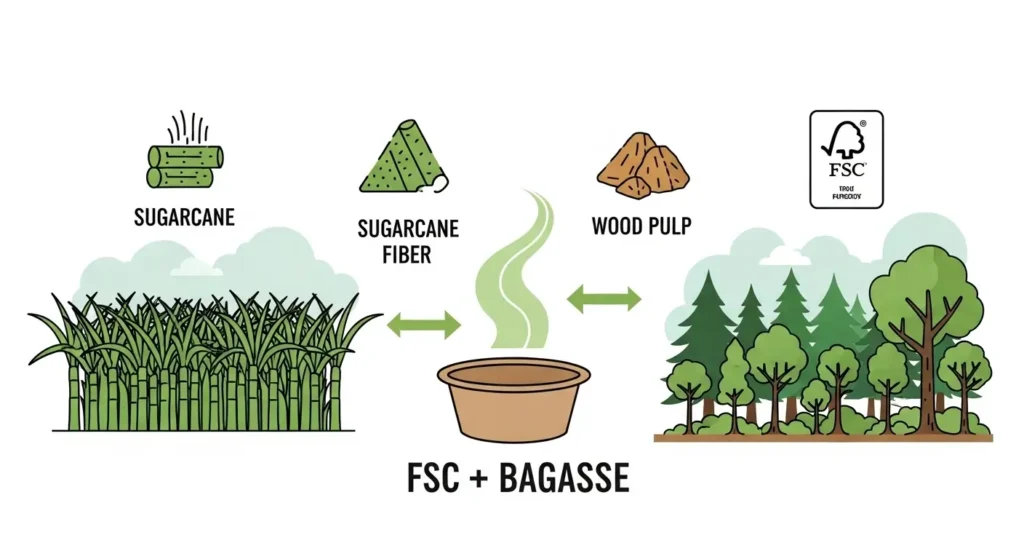
What Does FSC Certification Mean?
FSC certification verifies that materials used in packaging come from responsibly managed forests, recycled fibers, or controlled sources that meet strict environmental and social standards.
It ensures that every step—from raw material harvest to finished product—follows a transparent and traceable process.
There are three main FSC labels, each representing a different sourcing structure:

| Label | Definition | Typical Use Case |
|---|
| FSC 100% | Made entirely from FSC-certified forest materials. | Premium paper packaging, wood-based products. |
| FSC Recycled | Made entirely from post-consumer or pre-consumer recycled fibers. | Recycled cardboard, molded pulp packaging. |
| FSC Mix | Combines FSC-certified, controlled, and non-wood materials like bagasse under one verified system. | Most eco packaging products including sugarcane bagasse items. |
These labels appear on product packaging, export cartons, and marketing materials—allowing buyers and regulators to verify sourcing integrity instantly.
The Role of Chain of Custody (CoC)
A central part of FSC certification is the Chain of Custody (CoC) system.
It tracks materials throughout the entire production and distribution process to prevent unverified or illegal fibers from entering the supply chain.
How CoC works for packaging manufacturers:
- Each certified supplier or factory holds a unique FSC-CoC number.
- Every purchase and production batch is logged with documentation.
- Finished products include label references traceable to the certified source.
- Annual audits verify the data trail and compliance.
This documentation process gives both manufacturers and buyers a verifiable proof of transparency, which has become crucial for international trade and brand reputation.
Why FSC Matters for Eco Packaging Manufacturers
Regulatory Compliance
Many markets—especially the EU, UK, Australia, and Canada—increasingly rely on FSC certification to validate responsible sourcing under regulations such as:
FSC helps manufacturers demonstrate compliance with these sustainability laws, simplifying customs checks and supplier qualification.
Buyer and Retailer Trust
FSC certification signals to global buyers that your materials are ethically and legally sourced.
Large retailers such as Whole Foods, IKEA, and Costco actively prefer FSC-certified packaging suppliers for their transparency and audit-readiness.
Market Differentiation
In a market flooded with “eco-friendly” claims, FSC provides a verifiable benchmark.
It helps responsible manufacturers stand out from unverified competitors and secure long-term partnerships with sustainability-driven brands.
FSC and Non-Wood Fibers: Bagasse as an Example
While FSC was designed for forest products, the modern certification system has evolved to include mixed-material supply chains.
For bagasse packaging manufacturers, FSC participation doesn’t certify the sugarcane fiber itself—but it certifies the entire sourcing and production process under FSC Mix.
That means:
- All wood-based materials used alongside bagasse (like paper lids or outer boxes) are FSC-controlled.
- The production follows FSC-CoC documentation, ensuring traceability across every stage.
- The final product can carry the FSC Mix label to show complete sourcing integrity.
This integration allows bagasse packaging to meet both renewable material and traceable sourcing standards, creating a dual sustainability advantage.
How EcopulpPack Implements FSC Standards
At EcopulpPack, FSC compliance is part of our production DNA.
We follow a full FSC-CoC traceability framework across every manufacturing stage:
- Verified raw material suppliers under FSC or equivalent systems.
- Detailed batch labeling and documentation for each order.
- Regular third-party audits to ensure ongoing compliance.
- Assistance for clients in using FSC labels and preparing documentation for export or retailer audits.
By aligning FSC certification with bagasse production, EcopulpPack ensures every product delivered is both eco-conscious and audit-ready.
Conclusion
FSC certification is more than a logo — it’s a commitment to responsible sourcing, ethical manufacturing, and transparent trade.
For eco packaging manufacturers, especially those working with renewable fibers like bagasse, FSC represents a bridge between sustainability claims and verified performance.
As global regulations continue to tighten, FSC compliance is no longer optional — it’s the foundation of credibility in the sustainable packaging industry.
FAQ
-
What does FSC stand for?
FSC stands for Forest Stewardship Council, an international organization that promotes responsible forest management and sustainable fiber sourcing.
-
What is the main benefit of FSC certification for manufacturers?
It provides a traceable system (CoC) that proves all materials are sourced from verified, responsible, and legal origins — a key requirement for global buyers and retailers.
-
Can bagasse products carry the FSC label?
Yes, under FSC Mix certification, bagasse can be included in a verified supply chain where wood-based materials are certified and the production is traceable under FSC-CoC.
-
Is FSC certification mandatory?
Not legally mandatory, but in practice, many retailers and importers require it to qualify suppliers for sustainability and compliance reviews.
-
How long does FSC certification last?
FSC certificates are typically valid for five years, with annual audits to maintain compliance and documentation accuracy.
Ensure Your Packaging Meets FSC Standards with EcopulpPack
EcopulpPack provides FSC-CoC certified bagasse packaging solutions that meet the highest sustainability and traceability standards.
From verified raw materials to export-ready documentation, we help manufacturers and distributors achieve full compliance and buyer confidence.
👉 [Request FSC-Compliant Samples Today]
Sustainability starts with responsibility — let’s make your packaging truly traceable.