Why China Is Pushing Green Packaging
China is the world’s largest packaging producer and exporter. The new regulations support the “dual carbon” goals: carbon peak by 2030 and neutrality by 2060. Targeted industries include e-commerce, express delivery, food service, and retail. 2025 marks the stage of nationwide full enforcement.
Key Provisions of the 2025 Regulations
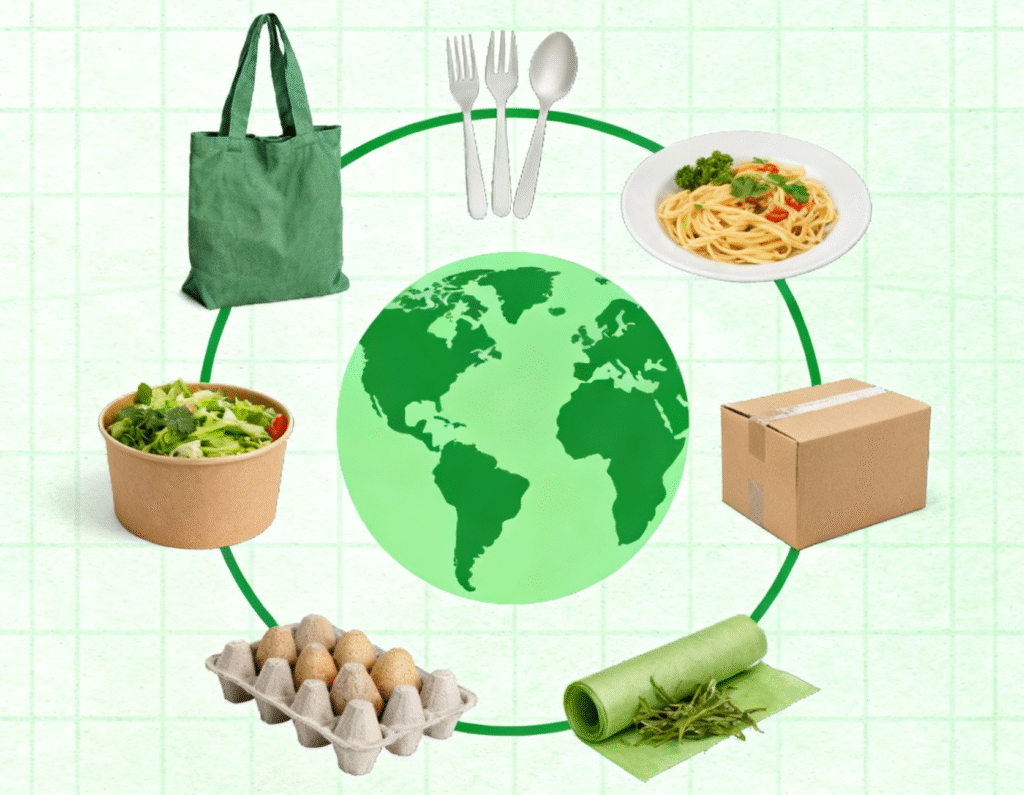
China’s 2025 green packaging regulations are not just a ban list; they represent a systematic shift in how packaging is designed, used, and recovered. The rules focus on reducing plastic pollution at the source while building a circular economy where packaging materials can be reused, recycled, or composted.
Materials Banned
The regulation identifies specific plastic items that are low-cost, high-pollution, and nearly impossible to recycle. These include:
- Non-degradable plastic bags: Thin plastic shopping bags and takeaway bags, which often end up in landfills or waterways.
- Plastic straws: Single-use straws widely used in beverage chains, now considered unnecessary plastic items.
- Expanded polystyrene (EPS) containers: Foam clamshells and cups, notorious for breaking into microplastics and polluting marine ecosystems.
Mandatory Requirements
The new rules go beyond bans and set active obligations for industries:
- E-commerce & logistics: Delivery companies must use packaging that is recyclable or compostable. Over-packaging and non-recyclable fillers are strictly restricted.
- Food service & takeaway: Restaurants, coffee chains, and delivery platforms must eliminate single-use plastics and adopt compostable packaging for meals and drinks.
- Eco-labeling: Packaging must carry clear recycling or compostability instructions so consumers can dispose of it correctly.
In practice, this means a coffee shop can no longer hand out a plastic straw, and an online store can’t ship goods with foam peanuts. Instead, they must use paper-based straws, molded fiber boxes, or certified compostable mailers.
Recommended Sustainable Alternatives

The government encourages the adoption of materials that already have proven industrial composting or recycling pathways. These include:
- Bagasse molded fiber: Made from sugarcane pulp, widely used for plates, bowls, and clamshells.
- Paperboard and recycled paper: Easily recyclable in existing waste systems.
- PLA and other bioplastics: Compostable under industrial conditions, suitable for coatings and lids.
- Bamboo pulp molded products: Renewable and biodegradable, offering higher durability. China’s 2025 Packaging Rules: Banned vs. Allowed Materials Banned Materials (Not Allowed) Allowed / Recommended Alternatives Non-degradable plastic bags (thin supermarket bags, takeaway bags) Paper bags, recycled paper packaging, reusable cloth bags Plastic straws (used in beverages, cafés, fast food chains) Paper straws, PLA biodegradable straws, bamboo straws Expanded Polystyrene (EPS) containers and cups (foam clamshells, takeaway boxes, foam cups) Bagasse molded fiber clamshells, paperboard containers, bamboo pulp cups Non-recyclable fillers & over-packaging (plastic bubble wrap, foam peanuts, multi-layer plastics) Molded pulp cushioning, corrugated cardboard inserts, compostable mailer
By highlighting alternatives, the regulation sends a clear signal: businesses must redesign packaging with sustainability in mind, rather than relying on cheap plastic.
Implementation Timeline (2020–2025)
China’s move toward sustainable packaging has been gradual, giving industries time to adapt. The 2025 milestone is the final stage of a phased strategy.
- 2020–2022 (Pilot & Initial Bans): Plastic straws banned nationwide in catering and beverage sectors. Non-degradable plastic bags prohibited in supermarkets, malls, and restaurants in major cities. EPS foam containers restricted in coastal regions due to marine pollution concerns.
- 2023 (Expansion & Enforcement): Food delivery platforms required to start replacing plastic containers with compostable options. E-commerce and logistics industries restricted from using excessive packaging and non-recyclable fillers. Local authorities empowered to fine and penalize non-compliant businesses.
- 2025 (Full Nationwide Enforcement): All industries (retail, food service, e-commerce, logistics) must comply with recyclable or compostable standards. Eco-labeling required on packaging to guide consumer disposal. Customs expected to strictly enforce packaging compliance for exports. Non-compliance may result in fines, shipment delays, or product recalls. China’s Green Packaging Regulations: Step-by-Step Timeline (2020–2025)
- 2020–2022: Initial Bans
- Plastic straws banned nationwide in catering and beverage sectors.
- Non-degradable plastic bags banned in supermarkets, malls, and restaurants in major cities.
- EPS foam containers restricted in key regions, especially coastal cities.
- 2023: Expansion & Enforcement
- Food delivery platforms required to start replacing plastic containers with compostable packaging.
- E-commerce and logistics industries restricted from using excessive packaging and non-recyclable fillers.
- Local authorities empowered to fine and penalize non-compliant businesses.
- 2025: Full Nationwide Enforcement
- All industries (retail, food service, e-commerce, logistics) must comply with recyclable or compostable standards.
- Eco-labeling required on packaging to guide consumer disposal.
- Customs expected to strictly enforce packaging compliance for exports.
- Non-compliance may result in fines, shipment delays, or product recalls.
This timeline shows that China is not improvising — it has been building a step-by-step roadmap. For global buyers, the takeaway is clear: by 2025, non-compliant packaging will no longer be tolerated anywhere in the Chinese market.
Who Is Affected?
The 2025 regulations touch nearly every link of the packaging chain. Different industries face different compliance pressures:
- Brands: For consumer-facing companies, packaging is both a regulatory matter and a branding tool. Brands selling in China must redesign packaging to meet eco-standards, including size reduction, recyclable materials, and eco-labeling. Even global companies exporting into China may be required to provide compliant packaging to avoid customs clearance problems.
- Manufacturers: Factories producing food containers, cups, or delivery packaging must shift away from plastic production lines and invest in biodegradable or recyclable materials. For many manufacturers, this requires not only new machinery but also certifications to prove compliance.
- Exporters and Trading Companies: Exporters face double pressure: they must comply with China’s domestic regulations while also meeting the sustainability requirements of destination countries. Non-compliant packaging could be flagged by Chinese customs and rejected by foreign buyers.
Implications for International Buyers
For global buyers sourcing from China, the new packaging rules have direct consequences.
- Supply Chain Risks Non-compliant packaging could result in goods being stopped at customs, leading to delays and unexpected costs. For buyers who depend on fast delivery and stable supply, this risk is unacceptable.
- Compliance and Certification Buyers must demand proof that their suppliers are using certified materials. International standards like EN13432, ASTM D6400, and OK Compost are commonly accepted benchmarks. Suppliers who cannot provide documentation may expose buyers to legal and reputational risks.
- Reputation and Market Advantage On the positive side, compliance offers a competitive edge. Brands that adopt certified bagasse, bamboo pulp, or recyclable packaging can highlight their sustainability achievements to consumers and investors.
Case Study: Transition with a Global Food Brand
Challenge: A European fast-food chain with over 500 outlets needed to eliminate plastic straws, EPS containers, and non-compliant takeaway packaging within one quarter. The brand faced tight deadlines because regulators announced random inspections, and the company feared negative media coverage if caught using banned materials.
Solution: We provided a full packaging replacement program:
- Supplied EN13432-certified bagasse clamshells and PLA-coated drink lids.
- Delivered compliance documentation in both English and Chinese for customs clearance.
- Assisted the brand in updating packaging designs with eco-labeling instructions.
Result:
- The company passed inspections smoothly with zero shipment delays.
- Customer engagement on social media increased by 25% after the launch of new eco-packaging.
- The company achieved zero customs detentions across all exports during the first compliance cycle.
- Its new packaging became the centerpiece of a sustainability marketing campaign, boosting customer trust.
- The fast-food chain extended its contract with us, shifting all takeaway packaging to certified compostable products.
Conclusion
China’s 2025 green packaging regulations represent more than a local policy change — they signal a global shift in how packaging will be designed and regulated. For businesses, compliance is not just a legal requirement, it is a strategic necessity.
- Brands must ensure packaging redesigns align with sustainability rules.
- Manufacturers need to upgrade to biodegradable and recyclable materials.
- International buyers must carefully vet suppliers and demand certifications.
In short: compliance protects your supply chain, while non-compliance puts your brand at risk.
FAQ
-
What packaging is banned in China in 2025?
Single-use non-degradable plastics such as bags, straws, and foam clamshells.
-
Are bagasse containers allowed under China’s green packaging law?
Yes, molded fiber products like bagasse plates, bowls, and clamshells are recommended.
-
How do international brands comply with China’s packaging regulations?
By sourcing from certified suppliers providing compostable packaging (EN13432, ASTM D6400).
-
What certifications are required?
EN13432, ASTM D6400, OK Compost, and China’s national eco-labeling system.
-
Will exports be affected?
Yes. Exporters must use compliant packaging to avoid customs problems and meet buyer expectations.
-
Will switching to compliant packaging significantly increase our costs?
While eco-friendly materials may have a slightly higher unit cost, they reduce long-term risks like customs fines and shipment rejections. As production scales up, the cost difference is narrowing. Moreover, they can be a valuable investment in your brand’s sustainability story, potentially increasing sales.
increasing sales.
Partner with EcopulpPack for 2025-Compliant Packaging
China’s 2025 green packaging regulations are a defining moment for global brands. Non-compliance could mean shipment delays, rejected orders, and reputational risks. But with the right partner, compliance becomes your competitive edge.
EcopulpPack helps international brands turn regulation into opportunity.
- ✅ Certified & Compliant: All products meet China’s 2025 standards and global certifications (EN13432 / ASTM D6400).
- ✅ Documentation Ready: Full test reports and certificates to support customs clearance and buyer audits.
- ✅ OEM/ODM Expertise: Custom solutions designed to match your brand’s sustainability goals.
- ✅ Trusted Worldwide: Supplying eco-packaging to 50+ brands across Europe, North America, and Asia-Pacific.
- ✅ Fast Samples, Reliable Scale: Free compliance samples and stable production capacity to secure your supply chain.
👉 [Get Your Free Compliance Audit with EcopulpPack]