What Is the FSC Chain of Custody
The Chain of Custody (CoC) is a documented control system that tracks FSC-certified materials through all stages — from forest or pulp mill to converter, packaging manufacturer, exporter, and retailer.
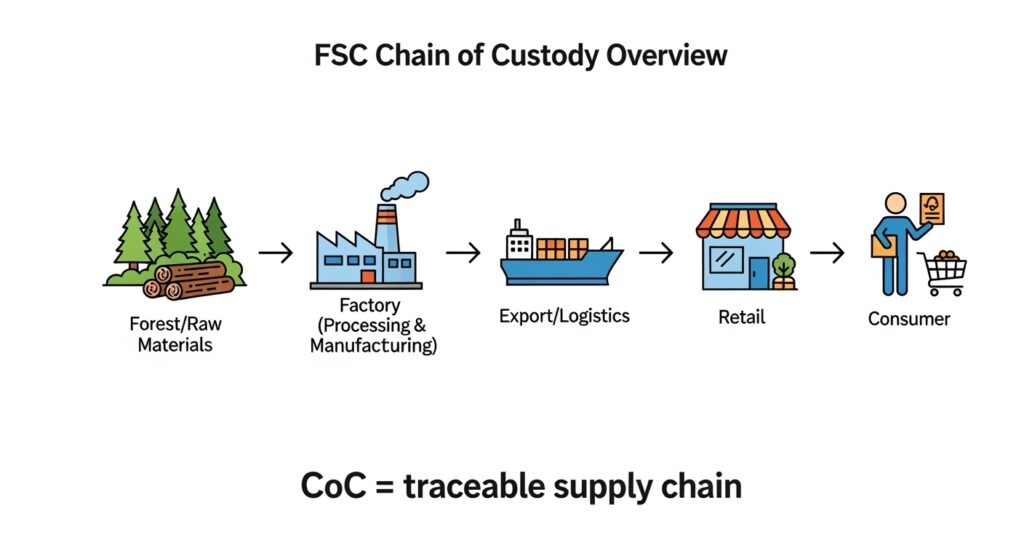
Its purpose is simple: to ensure that materials carrying an FSC claim really come from responsibly managed sources, and that their identity is preserved throughout production and trade.
Every company that takes ownership or transforms certified materials must have its own FSC-CoC certificate.
This includes:
- Raw material suppliers and pulp producers
- Packaging factories and converters
- Traders, exporters, and distributors
Without this unbroken chain, an FSC claim cannot appear on a final product or invoice.
How the Chain of Custody Works in Packaging Production
Material Sourcing and Verification
When manufacturers purchase raw materials (like FSC-certified paperboard or pulp), they must:
- Check supplier certificates on the FSC Certificate Database.
- Record each material’s FSC license code and claim type (e.g., FSC 100%, FSC Mix).
- Keep copies of supplier invoices and delivery documents.

These records form the first link in the CoC — proof that certified materials entered the system legally and traceably.
Internal Production Control
Inside the factory, all FSC materials must be handled under controlled conditions:
- Certified and non-certified materials are stored in separate areas.
- Each production order is assigned a batch ID tied to its material source.
- Operators and QC staff are trained to follow FSC work instructions for labeling, segregation, and record-keeping.
Factories may choose between two main tracking systems:
- Physical segregation: Separate production lines or clear identification at all stages.
- Percentage system: When mixing FSC and non-FSC materials, manufacturers calculate and declare the certified proportion under audit control.
Documentation and Invoicing
Every outgoing shipment must include:
- The factory’s FSC certificate code (e.g., FSC-CXXXXX)
- A clear FSC claim statement (e.g., “FSC Mix Credit”)
- Product quantity, description, and buyer’s name
- A reference to the related production batch or sales order
These details appear on invoices and packing lists, ensuring that certified goods can be verified at any point in the supply chain.
Annual Audit and Renewal
All FSC-CoC certified companies undergo annual audits by accredited certification bodies.
Auditors review:
- Supplier certificate validity
- Internal records and training logs
- Material storage and labeling areas
- Sample invoices and shipping documents
- Employee awareness and traceability practices
If any non-conformities (NCs) are found, corrective actions must be implemented within a defined period to keep certification active.
Key Documents in a CoC System
| Document Type | Purpose | Example |
|---|
| Supplier Invoice | Proof of certified material purchase | Lists FSC claim & license code |
| Material Log | Tracks batch entry into production | Excel sheet or ERP record |
| Production Record | Links material to product | Batch code, machine, date |
| Sales Invoice | Declares FSC claim to buyer | Must include FSC-C number |
| Training Record | Shows employee awareness | Signed attendance sheet |
| Audit Report | Issued by certification body | Verifies compliance annually |
These documents collectively demonstrate that an FSC-certified product was produced, stored, and sold within a verified traceable chain.
Why the Chain of Custody Matters
Strengthens Global Compliance
CoC is a globally recognized system that supports compliance with key environmental regulations, including:
- EU Packaging and Packaging Waste Regulation (PPWR)
- Australia APCO 2025 Targets
- EPR (Extended Producer Responsibility) systems Having a valid FSC-CoC certificate can simplify customs clearance and import approvals for eco packaging exporters.
Protects Against Greenwashing
FSC-CoC audits and document controls prevent false claims of “sustainability.”
Only verified suppliers can use the FSC logo, protecting buyers and consumers from misleading marketing.
Enhances Brand and Retail Trust
Retail chains, especially in Europe and North America, often require suppliers to hold FSC-CoC certification before listing them as approved vendors.
It serves as a third-party validation of responsible sourcing and traceability.
Provides Market Advantage
Manufacturers with valid CoC certification gain early access to tenders, retailer programs, and long-term partnerships with eco-conscious brands.
In short: CoC certification opens doors that “eco claims” alone cannot.
FSC Chain of Custody in Bagasse Packaging
Although bagasse is a non-wood fiber, it fits naturally into the FSC Mix system.
By combining FSC-certified pulp with renewable sugarcane fibers, manufacturers can offer dual-certified, traceable products.
This structure allows:
- FSC-controlled sourcing for all paper components (lids, wraps, cartons)
- Transparent documentation for bagasse blending
- Full audit traceability under the manufacturer’s CoC certificate
EcopulpPack’s system demonstrates that bagasse + FSC is not a contradiction — it’s a next-generation sustainable solution connecting renewable materials with verified global standards.
How EcopulpPack Maintains Chain of Custody Integrity
At EcopulpPack, the CoC process is built into every workflow.
We ensure:
- Certified Supplier Network: All pulp suppliers verified on the FSC database.
- Controlled Production Flow: Separate zones for certified and general materials.
- ERP-Based Record Management: Digital traceability from raw fiber to shipment.
- Annual Third-Party Audit: Continuous compliance verification.
- Buyer Documentation: FSC license codes, audit certificates, and declarations provided with every order.
Through these measures, EcopulpPack achieves full traceability, transparency, and accountability — giving global buyers documented assurance of responsible sourcing.
Real-World Buyer Scenario: Why CoC Certification Adds Value
Imagine a retail brand sourcing 100% compostable food packaging for EU distribution.
Even though the material is renewable, the buyer still needs FSC documentation to satisfy PPWR compliance and supply chain audit checks.
When EcopulpPack provides CoC-certified packaging, the brand can:
- Submit the FSC-CoC code directly in retail audits
- Avoid penalties for unverifiable sourcing
- Enhance consumer trust with certified labeling
In short, CoC documentation is not a formality — it’s a competitive asset that converts sustainability into measurable business credibility.
Frequently Asked Questions
-
What is the purpose of FSC Chain of Custody certification?
It ensures that materials used in a product come from responsibly managed, verified, and traceable sources, maintaining transparency across the supply chain.
-
Do all companies in the supply chain need FSC-CoC certification?
Yes. Each entity that takes ownership or transforms FSC materials must hold its own valid CoC certificate to maintain the unbroken chain.
-
How can buyers verify a supplier’s certification status?
-
What happens if a company loses its CoC certification?
It can no longer sell or label products as FSC-certified until corrective actions are approved by auditors and certification is reinstated.
-
How does EcopulpPack support documentation for buyers?
EcopulpPack provides FSC-CoC certificates, supplier chain references, and invoice-level claim statements to simplify buyer audits and customs documentation.
Ensure Full Supply Chain Transparency with EcopulpPack
EcopulpPack provides FSC-CoC certified bagasse packaging solutions designed for traceability and global compliance.
From verified raw materials to detailed export documentation, every order reflects our commitment to responsible sourcing and sustainability.
[Request FSC-CoC Documentation or Samples]