Building the Mental Model: The “Three Dimensions” of Tableware
Any serving item (cup, bowl, plate, container) can be defined by three independent, crucial dimensions: Capacity (Volume), Dimensions (Size), and Weight.
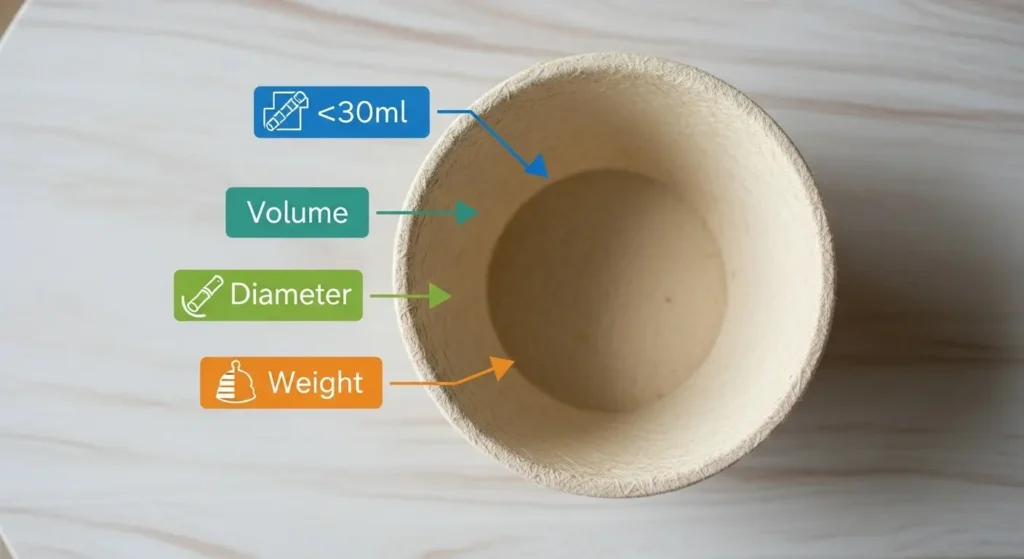
| Dimension | What It Measures | Key Units | Core Significance for Sourcing |
|---|
| Capacity (Volume) | Internal Space | Fluid Ounces (fl oz), Milliliters (ml) | Defines functionality: How much food or drink it can hold. |
| Dimensions (Size) | External Length/Width/Height | Inches (in), Centimeters (cm) | Defines compatibility: Whether it fits in dishwashers, cabinets, trays, or racks. |
| Weight | Mass of the Object | Grams (g), Ounces (oz) | Defines experience & cost: Impacts handling comfort, shipping costs, and waste weight. |
Solving Three Core Questions: How Much, How Big, How Heavy?
When you look at a product spec sheet, you’re essentially seeking answers to three questions. Let’s break them down.
Question 1: “How much does it hold?” – Understanding Capacity
This is about internal space, determining the item’s function.
- Key Units: Fluid Ounces (fl oz) & Milliliters (ml)
- Core Conversion: 1 fluid ounce ≈ 30 milliliters (A simplified standard for quick mental math in the food service industry).
- What You Must Know:
- Why are bowls and plates measured in “ounces”? Here, “ounce” refers to capacity, not weight. A “20oz bowl” means its internal space is equivalent to a container that can hold 20oz of liquid. This provides a unified, cross-category benchmark for capacity.
Quick Judgment: Multiply the ounce number by 30 to instantly know its approximate milliliter capacity. For example, a 12oz coffee cup equals about 360ml, perfect for a standard coffee serving.
- Sourcing Scenario: When selecting a container for your restaurant’s soup of the day, you should prioritize capacity (e.g., an 8oz/240ml bowl for a single serving) over its appearance or diameter.
Question 2: “How big is it?” – Understanding Dimensions
This is about the external footprint, determining compatibility.
- Key Units: Inches (in) & Centimeters (cm)
- Core Conversion: 1 inch = 2.54 centimeters
- What You Must Know:
- Diameter ≠ Capacity: Two plates both labeled “10 inches” can have vastly different capacities (in ounces) if one is shallow and the other is deep. Always consider dimensions alongside capacity.
- Quick Judgment: Multiply the inch number by 2.5 to quickly estimate centimeters. For example, a 10-inch plate is about 25cm wide.
- Sourcing Scenario: When ensuring new plates fit into your existing dish rack or meal delivery trolley, the listed length, width, height, or diameter (in/cm) is the mandatory hard specification to verify.
Question 3: “How heavy is it?” – Understanding Weight
This is about material feel and cost, directly impacting user experience and logistics.
- Key Units: Ounces (oz) / Grams (g) & Pounds (lb)
- Core Conversion: 1 ounce ≈ 28 grams | 1 pound = 16 ounces ≈ 454 grams
- What You Must Know:
- “Light” Doesn’t Mean “Low-Quality”: For materials like bagasse, lightweight is a core advantage stemming from natural fiber structure. This translates to lower shipping costs, easier handling, and reduced environmental burden as waste.
- Striking Comparison: A ceramic plate of the same size can weigh over 500g, while a bagasse plate can be as light as ~180g (~6.3oz). This difference in weight leads to significant savings in shipping and operational convenience when sourcing thousands of units.
- Sourcing Scenario: When purchasing disposable tableware for a large outdoor event or a takeout business, the single-unit weight (g/oz) multiplied by a large quantity has a major impact on your logistics budget and packing efficiency.
Here’s a quick-reference table summarizing the answers to these three questions:
| If you care about… | Focus on this unit | Core Conversion (Quick Estimate) | One-Line Sourcing Tip |
|---|
| Capacity (How much?) | Fluid Ounce (fl oz) / Milliliter (ml) | 1 oz ≈ 30 ml | Ounces × 30 = Milliliters. Ensure capacity matches your portion size. |
| Dimensions (How big?) | Inch (in) / Centimeter (cm) | 1 in ≈ 2.54 cm | Inches × 2.5 ≈ Centimeters. Ensure size fits your storage/transport space. |
| Weight (How heavy?) | Ounce (oz) / Gram (g) | 1 oz ≈ 28 g | Lower gram weight means lower shipping costs and easier handling. |
Next, let’s move into practical application, teaching you how to use this guide to crack the code of international sourcing and understand terminology differences.
Your Go-To Conversion Table: Quick Reference, Instant Clarity
Once you grasp the core concepts, you need a quick “translator.” This table summarizes the most critical conversion relationships in tableware sourcing.

| If You See | Quickly Convert To | Conversion Tip & Use Case |
|---|
| Capacity | 1 Fluid Ounce (fl oz) | ≈ 30 Milliliters (ml) |
| Dimensions | 1 Inch (in) | = 2.54 Centimeters (cm) |
| Weight | 1 Ounce (oz) | ≈ 28 Grams (g) |
| Bulk Weight | 1 Pound (lb) | ≈ 454 Grams (g) |
How to Use This Table:
- On-the-Spot Use: When you encounter unfamiliar “oz” or “in,” use this table directly for conversion.
- Reverse Calculation: You can also divide milliliters by 30 to estimate ounces.
- Priority Check: In sourcing, Capacity and key dimensions (like diameter or length) are usually the two metrics you need to prioritize for comparison.
International Sourcing in Action: When Spec Sheets Come from Around the World
When your suppliers, target markets, or e-commerce platforms span different countries, the same product can be described in entirely different “languages.” This section provides a clear methodology to tackle this.
1. The Core Dilemma: One Product, Many “Faces”
Imagine you need to source a rectangular food box for takeout salads. During your research, you might encounter these three descriptions:
| Source Region | Product Specification Description | Your Initial Confusion |
|---|
| U.S. Supplier | 32 oz Rectangular Takeout Container<br>Dimensions: 9″ L x 6″ W x 3″ H | “What is 32 oz exactly? Will this size hold our standard salad portion?” |
| European Supplier | 950 ml Food Box, Compostable<br>Size: 23cm L x 15cm W x 7cm H | “Is 950 ml the same as the 32 oz above? The length and width seem different too.” |
| Domestic Supplier (China) | Compostable Takeout Box, 1000 ml<br>Specs: 24cm L x 16cm W x 8cm H | “All three are different. Which one do I compare?” |
This is likely the same product, not three different ones. The discrepancy stems from: 1) Different units for capacity and dimensions; 2) Possibly slight variations in how product height is measured (e.g., with or without lid).
2. The Decoding Process: Your Four-Step Translation Guide
Follow these steps to “translate” any international spec sheet into terms you understand.
Step 1: Unify Capacity Units (Solve “How Much?”)
- Action: Apply 1 oz ≈ 30 ml.
- In Practice:
- US Spec 32 oz → 32 × 30 = 960 ml
- EU Spec 950 ml → 950 ml
- CN Spec 1000 ml → 1000 ml
- Conclusion: The capacities are very close (within ~5%), belonging to the same size tier. Minor differences may arise from measurement standards or rounding.
Step 2: Unify Dimension Units (Solve “How Big?”)
- Action: Apply 1 in = 2.54 cm.
- In Practice:
- US Spec 9″ L x 6″ W → 9×2.54≈22.9cm L, 6×2.54≈15.2cm W
- EU Spec 23cm L x 15cm W → 23cm L, 15cm W
- CN Spec 24cm L x 16cm W → 24cm L, 16cm W
- Conclusion: The length and width are also highly comparable. You should now ask: Is this size range (~23-24cm long) suitable for your racking, packing process, and food presentation?
Step 3: Understand Terminology & Context (Solve “What’s It Called?”)
- Action: Identify and understand the market-specific terminology in the product description.
- Key Insight: “Takeout Container” (US), “Food Box” (EU), and “外卖盒” (CN) refer to the same product category here. Using terminology that matches your target market’s search habits is key for efficient sourcing and marketing. For instance, if your primary market is the UK, you should prioritize searching for “Takeaway Box.”
- Pro Tip: For optimal search visibility and customer communication in your target market, choosing the right term (Takeaway, To-Go, or Takeout) is as crucial as selecting the correct size and capacity. To optimize your product listings and marketing copy, you can read our detailed breakdown and recommendations for takeout terms based on your target region.
Step 4: Evaluate Material & Craftsmanship (The Core Reason for Choosing Bagasse)
- Action: After confirming specifications align, return to your original purpose—sustainability and performance.
- Key Questions: Regardless of how specs are written, confirm:
- Is it made from 100% bagasse or other plant fibers?
- Does it have Compostable certification (e.g., BPI, OK compost HOME)?
- For your required capacity, what are its oil-resistance, water-resistance, and load-bearing capabilities? (For example, our bagasse clamshells are designed with reinforced structure to hold saucy foods.)
3. Your Quick-Reference Tool Table
Condensing the steps above, here’s a table for quick consultation:
| If You See | Quickly Convert/Relate To | Application Scenario |
|---|
| Capacity | 1 Fluid Ounce (fl oz) | → × 30 → Milliliters (ml) |
| Dimensions | 1 Inch (in) | → × 2.54 → Centimeters (cm) |
| Weight | 1 Ounce (oz) | → × 28 → Grams (g) |
| Terminology | Takeout (US) | ≈ Takeaway (UK/AU) |
By following this “decoding” process, you can cut through the fog of international specifications, compare products based on their core parameters, and make informed global sourcing decisions based on actual specs, eco-standards, and cost-effectiveness.
Conclusion: From Confusion to Insight – Empowering Your Choices with Knowledge
Through this guide, we hope you’ve gained not just a set of conversion formulas, but a framework for thinking that reveals the true value behind product specifications.
Numbers like “12 oz,” “9 in,” or “150 g” on a label are no longer confusing codes but clear data you can instantly interpret:
- “12 oz” means it can hold about 360 ml of soup or a drink.
- “9 in” tells you its diameter is roughly 23 cm, letting you judge if it fits your cabinet.
- “150 g” lets you intuitively feel it’s lighter than a smartphone, signaling lower logistics costs and easier handling.
Understanding these units essentially grants you three freedoms:
- Freedom of Choice: You can calmly compare products from global suppliers, making fair, apples-to-apples comparisons based on unified specs.
- Freedom of Budget Control: You can accurately assess how capacity, dimensions, and weight impact per-use cost and overall operational efficiency.
- Freedom to Practice Sustainability: You can move beyond the “eco-friendly” label and make intelligent assessments at every stage—from material (like bagasse) and craftsmanship to the product’s entire lifecycle.
Your Next Steps
Knowledge is meant to be applied. Now, you can:
- Re-evaluate Your Needs: With this new understanding, review your restaurant, event, or business’s real tableware needs—do you need to optimize for capacity, dimensions, or weight most?
- Seek Clear Specifications: When browsing any product, actively look for and verify these key data points. All our bagasse products (from containers and plates to cutlery) provide complete, transparent specification information on their detail pages for you to apply your learning.
- Start an Informed Comparison: Use this article as a guide to place our products and any others you’re considering side-by-side under the same standard for a fair comparison. We believe truly excellent products withstand scrutiny from every dimension.
Thank you for reading. May you find the most satisfactory solutions for your business while making better choices for our planet.
Explore Detailed Guides by Product Category
We have prepared in-depth sourcing guides for specific product categories. Dive deeper:
Containers & Takeout Packaging: Restaurant Essential: How to Choose the Right Size & Capacity Bagasse Takeout Containers for Your Menu (Coming Soon)
Cups: Bagasse Cup Size Chart: Convert 12–32 oz to Cups (with mL Equivalents) – Use Cases & Buying Guide
Plates: Disposable Plate Size Guide: Standard Dimensions in Inches and Centimeters
Bowls: Bagasse Bowl Buying Guide: From 8oz to 32oz – A Complete Breakdown of Capacity, Size & Use Cases (Coming Soon)
More Than a Guide, It’s a Commitment from EcoPulpPack
At EcoPulpPack, we believe true sustainability lies in the details—from millimeter-perfect specification accuracy to materials that leave zero burden on the planet. This article is not just a sourcing guide; it reflects our commitment to bringing transparent, reliable, high-performance eco-friendly solutions to the market.
Every bagasse product we offer is a fulfillment of this promise. We invite you to explore how our products can support your business, armed with the knowledge from this guide.
Let professional choices build a sustainable operation:Explore EcoPulpPack Solutions
Frequently Asked Questions (FAQ)
-
I often mix up whether “ounce” (oz) means weight or capacity. Is there a simple way to tell?A: This is common. The key is context and accompanying units:
For Capacity (Volume): It’s typically paired with milliliters (ml) or describes holding ability, e.g., “12 oz Cup.” Here, 1 fluid ounce ≈ 30 ml.
For Weight (Mass): It’s typically paired with grams (g) or describes the product’s net weight, e.g., “Product Weight: 2 oz.” Here, 1 ounce ≈ 28 g.
Simple Rule: If it’s about how much food/drink it holds, think capacity. If it’s about how heavy the item itself is, think weight.
-
In practical sourcing, which is more important: capacity (ounces) or dimensions (inches)?A: It depends on your primary constraint:
Capacity First: When you need precise portion control, cost calculation, or standardized plating (e.g., a fixed 10 oz soup), capacity is the absolute primary metric.
Dimensions First: When you must ensure the item fits existing storage, transport, or display spaces (e.g., a specific trolley rack), external dimensions are the hard limit.
Best Practice: Combine both. First, ensure capacity meets functional needs, then verify dimensions fit your physical space.
-
Is the “lightness” of bagasse tableware the same as plastic tableware’s “lightness”?A: While both feel lightweight, they are fundamentally different:
Plastic’s Lightness: Comes from petroleum-based materials. This “lightness” can come with risks of being flimsy, bending easily, or softening under heat.
Bagasse’s Lightness: Comes from the porous structure of natural plant fibers, compacted with modern technology. It achieves lightweight while maintaining high strength, heat resistance (usually up to 120°C/248°F), and good rigidity. This is a “sturdy lightness” that balances eco-performance with user experience.
-
For the US market, which term is more professional/effective on products and packaging: “Takeout” or “To-Go”?A: It depends on your audience and context. Understanding the difference boosts professionalism and search visibility:
For B2B Sourcing & Product Catalogs: Prioritize “Takeout”. It’s a standard, universal industry term common in product names, supplier catalogs, and B2B platforms (e.g., “Compostable Takeout Containers”). It casts the widest net when business buyers search.
For End-Consumer Context & Packaging Labels: “To-Go” is more situational. It directly describes the “ready-to-leave” state. Using it on packaging (e.g., “Eco-Friendly To-Go Box”) or menus instantly resonates with the consumer’s use case.
Core Advice: Search both keywords during market research. Strategically use both in your own materials: Use “Takeout” in titles/main categories, and incorporate “To-Go” in packaging visuals/scene descriptions.
-
Following this guide, how do I start choosing the right bagasse plates for my restaurant?A: You can follow a simple three-step process:
1.Determine Capacity: Decide the capacity needed for an average main course (e.g., steak with sides). You might need at least a 40 oz / 1200 ml plate.
2.Measure Key Dimensions: Measure the available space in your dishwasher rack, service trays, or cabinets. Determine the maximum allowable diameter or dimensions (e.g., diameter ≤ 12 inches / 30.5 cm).
3.Verify Performance: Among products meeting #1 and #2, confirm the material (100% bagasse?), certifications (compostable?), and performance (oil resistance?). Our Bagasse Plates Series page provides detailed spec data for easy comparison.